
Validated foundation
Operations infrastructure
Flow Ops
Build the operating system your service business actually needs.
Flow Ops organizes the contracts, configuration, security boundaries, and product surfaces needed to create focused SaaS and white-label service platforms without rebuilding the foundation for every vertical.
Discuss Flow Ops
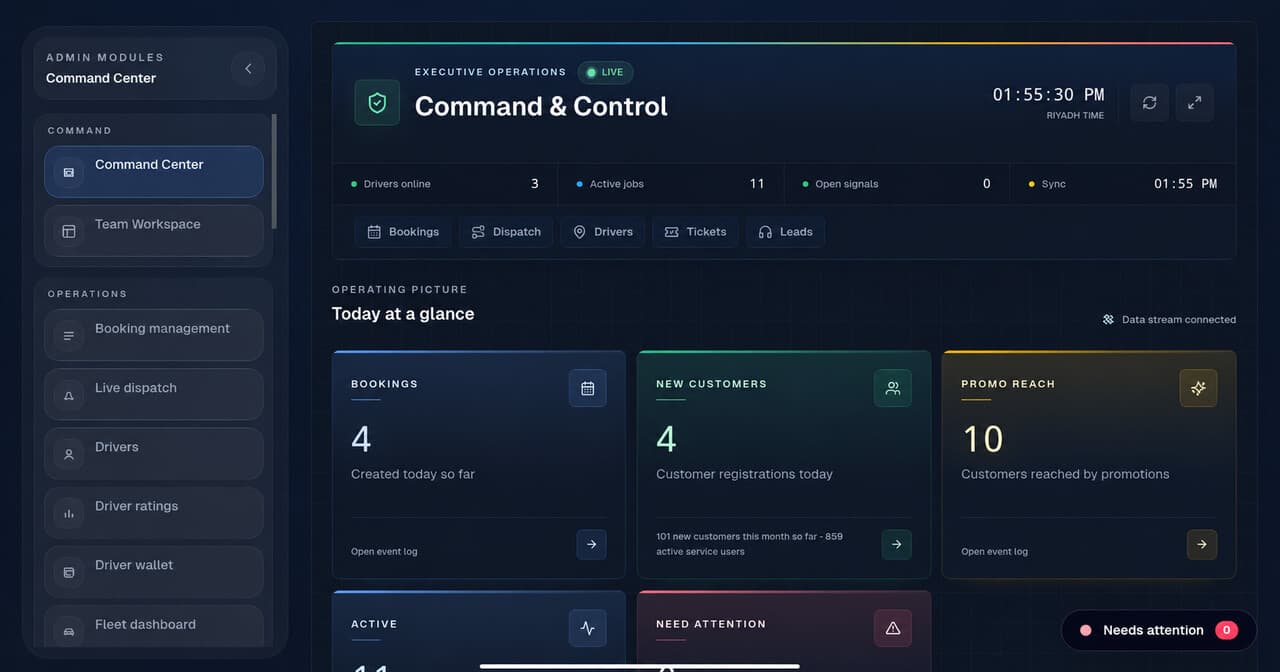
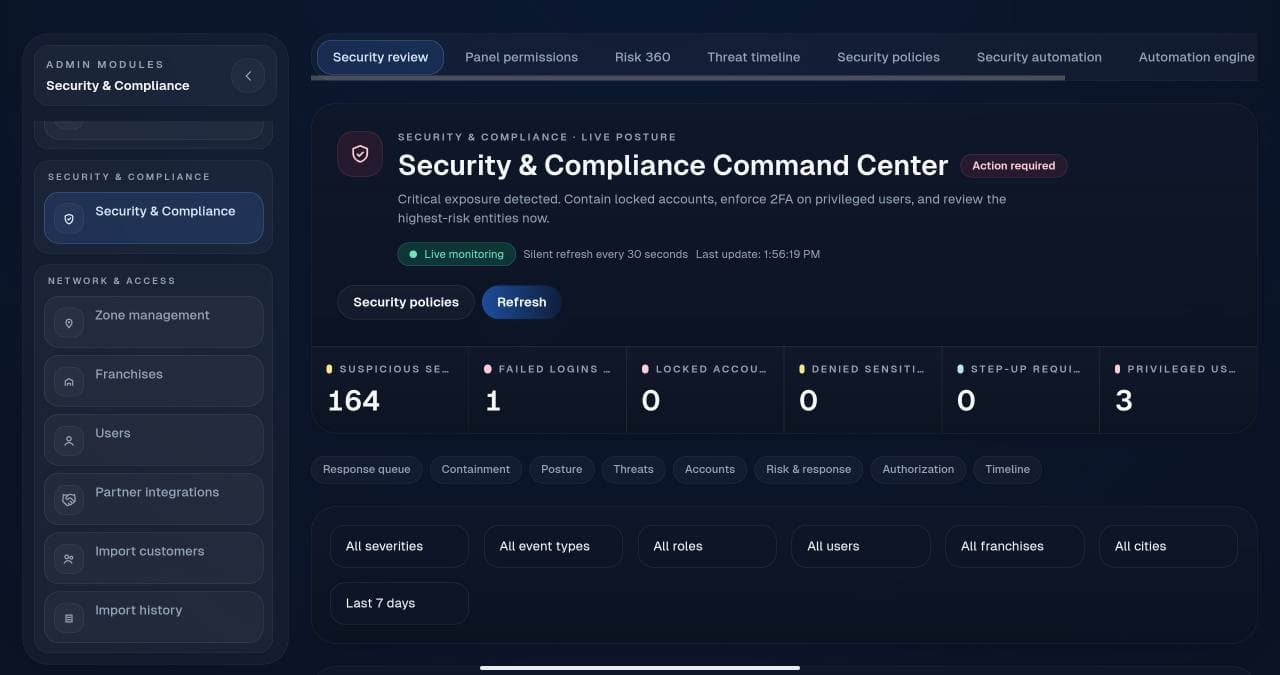
FlowOps operational surfaces
Command, control and security in one operational foundation.
Command & Control
Live visibility across bookings, dispatch, drivers, tickets and operating performance.Security & Compliance
Continuous posture monitoring, risk review, policy enforcement and response workflows.Maturity boundaries
What is validated, configurable and planned.
Current · Validated foundation
Validated platform contracts, vertical definitions, configuration examples, generator tooling, and product shells.
Configurable
Capability declarations and product shells are ready to be connected to selected runtime modules.
Roadmap
Full commercial multi-tenant runtime, metering and billing, production API management, and vertical-specific production deployments.
Product overview
A configurable operations foundation for service businesses.
Flow Ops is a product-neutral platform foundation for multi-tenant service operations, vertical configuration, branded applications, partner APIs, and enterprise deployments.
- Shorten the path from a vertical idea to a governed product foundation.
- Keep tenant, application, plan, and API-client concerns explicit.
- Standardize operational capabilities without forcing every industry into one workflow.
- Create a controlled route to shared SaaS, dedicated, white-label, API, and enterprise delivery.
Product pillars
Operational core
Capability contracts cover booking lifecycles, scheduling, dispatch, SLA, fleets, stations, payments, evidence, ratings, tickets, reporting, and automation.
Product configuration
Vertical, tenant, plan, app-instance, and API-client definitions separate reusable platform behavior from product-specific rules and branding.
Governance by design
Security, roles, permissions, audit, fraud, risk, notifications, and observability are represented as first-class platform concerns.
Multiple delivery models
The architecture is designed for shared SaaS, dedicated deployments, white-label applications, partner APIs, and enterprise environments.
Operating workflow
- 01
Define the target vertical and terminology.
- 02
Select and configure capability contracts.
- 03
Create tenant, plan, application, and API-client policies.
- 04
Generate product configuration and connect runtime modules.
- 05
Validate boundaries before deployment and commercialization.
Designed for
- Service marketplaces and field-service operators
- Franchise and multi-branch service businesses
- Companies building a white-label service product
- Enterprises exposing services through partner APIs
Deployment models
- Shared SaaS
- Dedicated tenant
- White-label web and mobile
- API partnership
- Enterprise deployment
Integration boundaries
- Payment providers
- Maps and geolocation
- Push, email, and messaging providers
- ERP and finance systems
- Partner applications and webhooks
Flow Ops
Design a service platform around your operating model.
Start with a vertical discovery and capability-mapping workshop with Diamond Shield.
Discuss Flow Ops